Full written text of Professor Jorge Humberto Dias' speech at the World Happiness Summit (2026)


What did we explore in the last panel of the World Happiness Summit (2026)?
This panel raised a simple but important question: If the science of well-being is producing results globally, why do places with the greatest access to this science often lag behind—and what is needed to incorporate the science into real institutions?
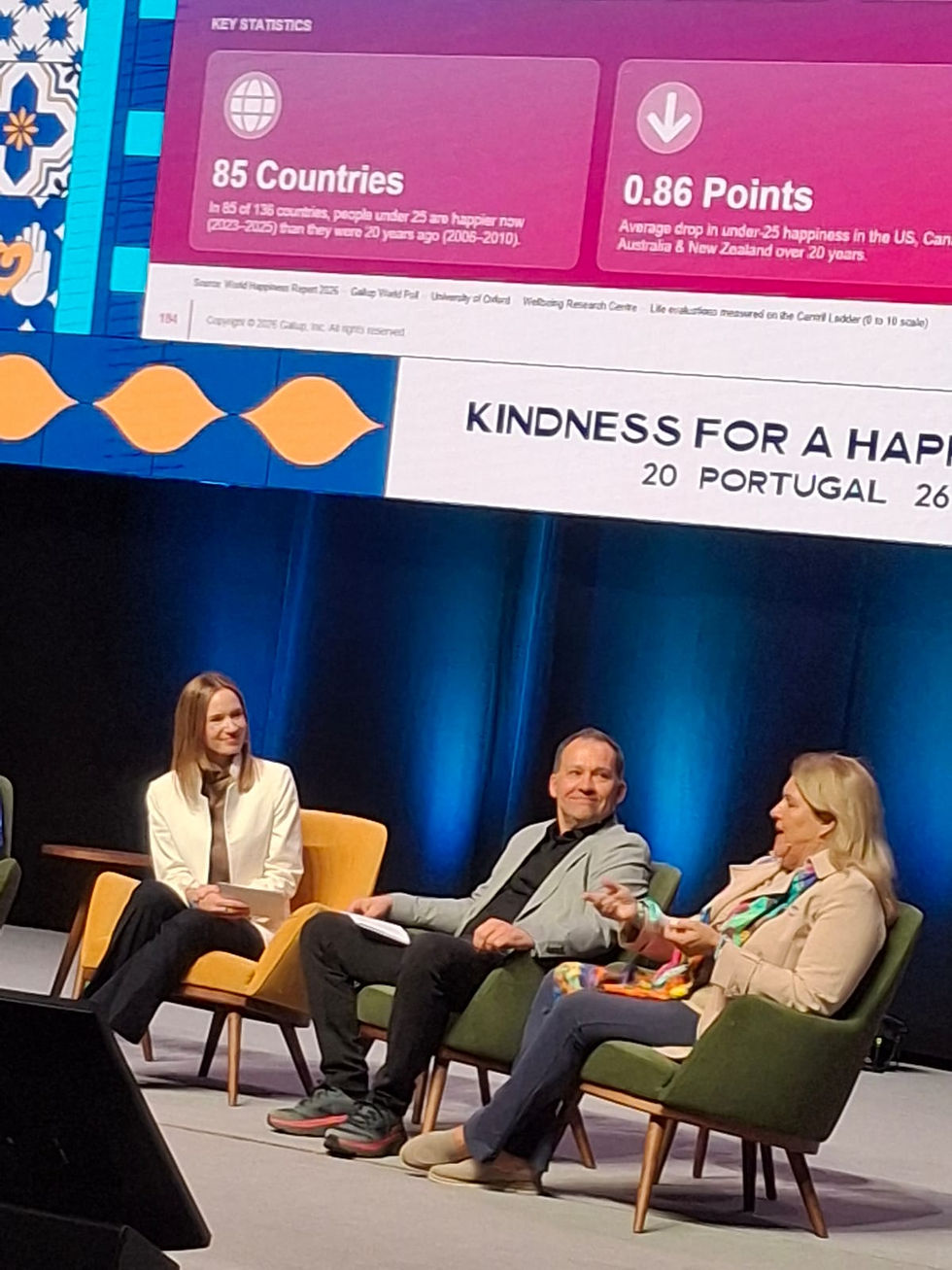
The session will begin with data from the 2026 World Happiness Report and Gallup to contextualize the global landscape. The questions moved from diagnosis to practical examples and to hope.
Moderator:
ANNIKA LEONHARD
Consulting Director - EMEA
GALLUP®
Question | The Paradox
For the first time ever, no English-speaking country appears in the top 10. Costa Rica ranks 4th. Mexico 12th. Both above the United States. “Here’s what makes this harder: for the first time in history, not a single English speaking country appears in the top 10 happiest nations and yet these are the same countries with the most universities, the most research, the most access to the science of wellbeing. Costa Rica sits at 4th in the world. Mexico at 12th. Both above the United States.”
– Prof. Dias: What does that tell us about the relationship between knowing the science and actually living it?
“This paradox shows that knowing about happiness is not enough — we must be able to structure it. In the data we collect through (h)Appy‑Phi, we often see that people already value happiness and well-being very highly. For example, in one study, 95% of participants said that happiness and well-being are part of their personal philosophy of life. And yet, that does not automatically translate into higher happiness outcomes. Why? Because happiness is not built at the level of ideas — it is built at the level of projects. In the PROJECT@ method, I show that happiness requires identifying projects, aligning them with values, and integrating them into life. So we have learned what happiness is — but we have not yet learned how to organize life around it. That is the gap between knowing and living.”
“In this final part of the Summit, you will hear about challenges you may not have considered before… In my experience of nearly 30 years working on the topic of happiness, I still feel that there is a significant lack of happiness literacy. Today we are in a better place, as there are now many projects, courses, and publications on the topic. However, I often feel that we circle around the concept of happiness and forget its central essence: who am I, and what truly makes me come alive? I see myself as a fundamental project — always under construction over time — that seeks to have family, friends, peace, and meaningful work with impact. We need to teach people how to develop project-based competencies — the ability to design, structure, and live meaningful projects. What do you think about this? Examples? Self-definition, Temporal awareness, Ethical alignment, Life integration, Meaning-making, Reality-testing, Commitment to continuous becoming. In my first book, published in 2006, I created the PROJECT@ method, which I later developed in my PhD in 2013. In that same year, Jeffrey Sachs wrote in the World Happiness Report that the path for governments would be to apply the philosophical theory of Aristotle. That is exactly what we are trying to do in Portugal. We created the Happy Schools programme — a partnership between the Ministry of Education and Atlântica University Institute — and we are now in our 12th edition. We have also launched the Happy Universities programme. We developed the first standard in the world (NP 4590:2023) for well-being and organizational happiness management systems. We have already delivered several courses on how to apply it in organizations. The foundation of the standard is Maslow’s pyramid, with its five types of human needs. The next step? We have already translated it into English and are now working with ISO so that it can soon become an international standard. Having a system makes all the difference — and helps avoid “happywashing.” We need to embed happiness into the culture of organizations, including clear objectives and targets in strategic documents and plans.
Then, we carry out a diagnosis through a questionnaire. Based on that, we create an action plan, and at the end we evaluate the results.
It is a virtuous cycle that should be implemented every year.
I conclude with my definition of happiness, published in the Portuguese Standard for Organizational Well-being and Happiness Management Systems:
“Happiness is a personal and dynamic perception of consciousness, subject to the dynamics of time, with particular attention to the future. It comprises subjective and objective dimensions, both associated with ethical values, and is grounded in systemic and periodic evaluations of projects accomplished throughout a given existence, considered as a whole. Its focus lies in the intensity and depth of projects, whether personal or organizational, both of which are guided by the principle of continuous improvement.” (Dias, 2022)
Closing Prompt
Prof. Dias: “If someone in this room could do one thing this week to create a ripple of happiness in their school, organisation, or community…what would you tell them?”
“If I could suggest one thing: develop your capacity to build meaningful projects — define who you are, align with your values, and act consistently. That is how happiness becomes real and sustainable.”
In preparing for this Summit, Professor Jorge Humberto Dias also reflected on the questions that were put to the other speakers on the Panel:
Question | The Challenge
Under-25s in North America, Australia & New Zealand rank 122nd–133rd out of 136 countries for wellbeing change since 2010; yet 79 countries have become happier over the same period. “The World Happiness Report 2026 shows some stark outliers: in North America, Australia, and New Zealand, under-25s rank 122nd–133rd out of 136 countries for wellbeing improvement since 2010. This is the steepest youth decline anywhere. However, 79 countries have become happier over the same period. So, this isn’t inevitable; it’s a preventable failure.”
– What role can schools and institutions play in reversing this drop? (Follow-up: What is it that these countries are getting wrong?)
Response from Professor Jorge Humberto Dias:
“I would say that we are asking young people to feel happy in systems that are not designed for human development. In my work, happiness is a dynamic perception of life, depending on how we build and evaluate our projects over time. What we see in organizations reflects the same structural issue. In one of our studies using the (h)Appy‑Phi approach, more than 79% of people recognized a strong connection between personal happiness and organizational conditions. This tells us something important: happiness is not just individual — it depends on the systems people are part of. If young people do not find environments — like schools — that support meaningful projects, relationships, and purpose, their well-being will decline, even if they have more resources than ever before. So the problem is not the individual — it is the design of the system.”
Question | The Friction
Data shows that the Life Evaluation Index (Gallup % thriving) has continued to inch upward globally — proof that change is possible. So where does it still break down? “Implementation is where good intentions meet real friction: limited budgets, sceptical leadership, competing priorities. Gallup’s data shows that the % of the population who say they are thriving has been rising for a decade.”
– We know change is possible. But tell us about a moment in your own work where embedding wellbeing into an institution was harder than expected. What did you learn from it?
Response from Professor Jorge Humberto Dias:
“When we try to implement well-being in organizations, friction appears very quickly — and the data helps explain why. In our (h)Appy‑Phi study, about 91% of employees said their personal philosophy could align with their organization. So the intention is there — alignment is possible. However, at the same time, around 20% reported clear inconsistencies between their own definition of happiness and how the organization actually operates.
And even more interesting:only about 45% were aware of a code of ethics in their organization, while 29% didn’t even know if it existed. This shows that friction is not about resistance — it is about lack of clarity, communication, and coherence. People are ready for happiness. Systems are not always ready to support it.”
Question | The Ripple
In 85 of 136 countries, young people are happier today than they were 20 years ago. The tide is coming in — just not everywhere, and not yet. “The WHR data gives us something quietly remarkable: in 85 of 136 countries, young people are actually happier today than they were 20 years ago. The tide is coming in, just not everywhere, and not yet.”
– Where have you seen a small, deliberate intervention create an effect that spread further than you expected - a genuine ripple? What made that possible?
Response from Professor Jorge Humberto Dias:
“We also see that small changes can create strong ripple effects — but only when they are consistent. In the same study, the average happiness score in the workplace was around 7.7 out of 10, and job satisfaction was even higher, above 8. So the system is not broken — but it is incomplete. And what drives the biggest positive effects? Not programs, but very concrete factors: recognition, respect, relationships, and communication. When these are improved — even slightly — they influence behavior, then culture, and then the whole system. That is how a ripple of happiness is created: not from intention, but from consistent, value-driven action.”
Link to the YouTube channel with recordings from the audience about Professor Jorge Humberto Dias's presentations:


Comentários